



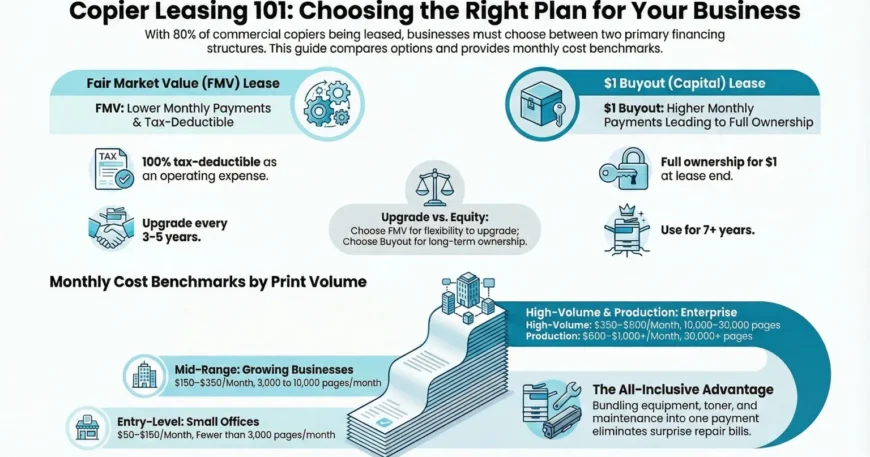
If you’re researching copier lease options for your business, you’re not alone—8 out of 10 commercial copiers are financed through some type of leasing program. But navigating copier lease agreements, understanding pricing, and avoiding common pitfalls can be overwhelming.
This comprehensive guide covers everything you need to know about copier leasing: how it works, what it costs, the different lease types, and how to get the best deal for your business.
What Is a Copier Lease?
A copier lease is a financing arrangement where your business rents a copier or multifunction printer (MFP) from a leasing company rather than purchasing it outright. Instead of paying $5,000 to $30,000 upfront for equipment, you make predictable monthly payments over a set term—typically 36, 48, or 60 months.
Your monthly lease payment covers the cost of the equipment plus financing charges, spread across the lease term. Most businesses also have a separate service and maintenance agreement that covers repairs, parts, and supplies like toner.
Key components of a copier lease:
- Equipment cost (the copier itself)
- Financing/interest charges
- Lease term length (36-60 months)
- End-of-lease options (return, purchase, or upgrade)
- Service agreement (often separate from equipment lease)
How Much Does It Cost to Lease a Copier?
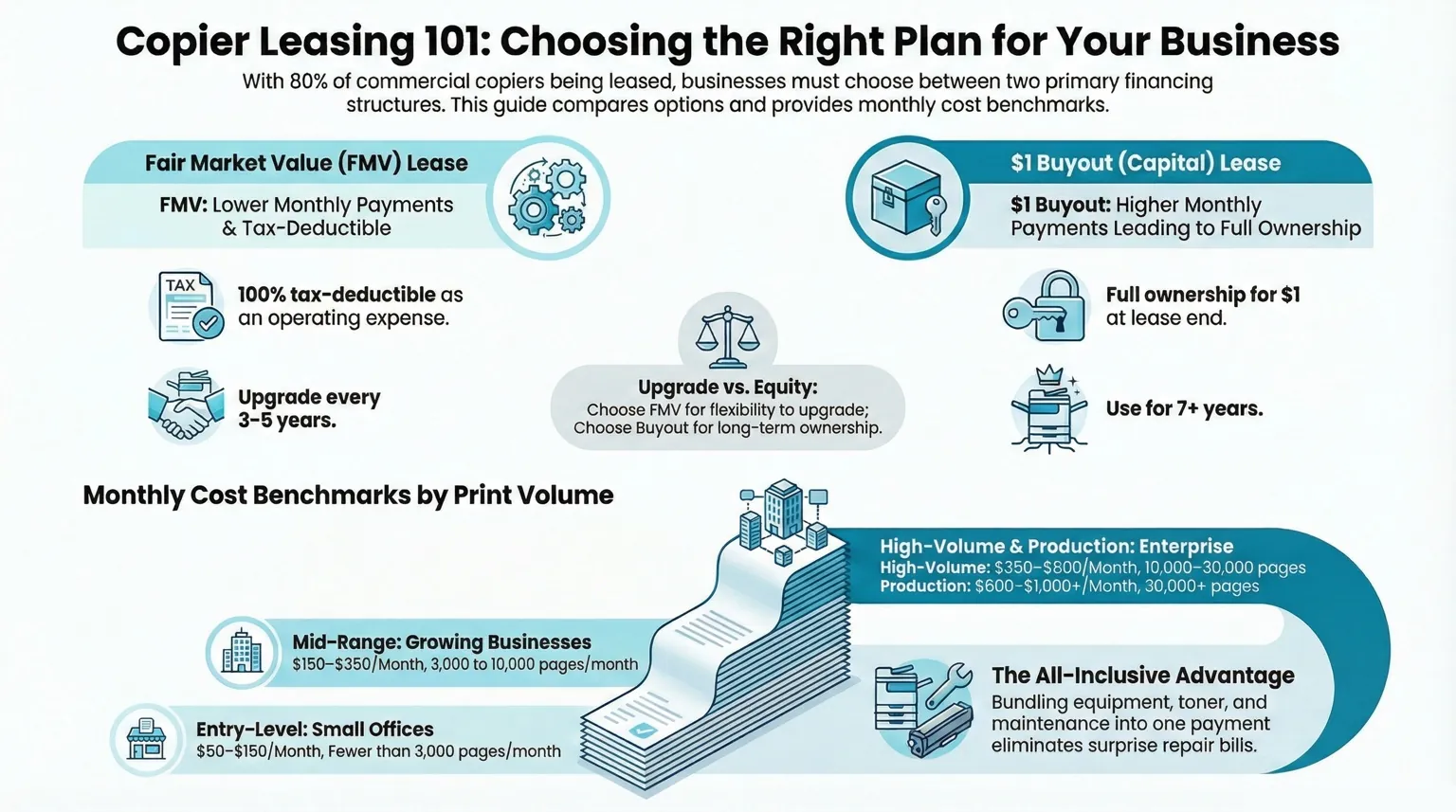
Copier lease costs vary significantly based on the equipment’s capabilities, your print volume needs, and the lease term. Here’s what businesses typically pay:
Entry-Level Copiers: $50-$150/month
- Black-and-white only or basic color
- Print speeds of 25-35 pages per minute
- Best for small offices printing under 3,000 pages monthly
- Example: Small law firm leasing basic B&W copier for $49/month
Mid-Range Copiers: $150-$350/month
- Full-color multifunction (print, copy, scan, fax)
- Print speeds of 35-50 pages per minute
- Best for growing businesses printing 3,000-10,000 pages monthly
- Example: Insurance office leasing color MFP for $220/month
High-Volume Copiers: $350-$600/month
- Advanced color with finishing options
- Print speeds of 50-70 pages per minute
- Best for busy offices printing 10,000-30,000 pages monthly
- Example: Marketing agency leasing high-end color copier for $425/month
Production Copiers: $600-$1,000+/month
- Enterprise-grade with booklet making, high-capacity trays
- Print speeds of 70-110+ pages per minute
- Best for print-heavy environments printing 30,000+ pages monthly
- Example: Engineering firm leasing production copier for $975/month
Important: These prices typically cover just the equipment lease. Service, maintenance, and supplies may be billed separately or bundled into an all-inclusive agreement. Always compare the total cost of ownership, not just the equipment payment.
Types of Copier Leases Explained
Understanding the two main lease types is critical—they have very different implications for your monthly costs and end-of-lease options.
Fair Market Value (FMV) Lease
Also called an operating lease, this is the most common type of copier lease.
How it works:
- Lower monthly payments (you’re not financing the full equipment cost)
- At lease end, you can return the equipment, purchase it at current market value, or upgrade to new equipment
- Payments are typically 100% tax-deductible as operating expenses
- Equipment doesn’t appear on your balance sheet
Best for:
- Businesses that want access to the latest technology
- Companies that prefer to upgrade equipment every 3-5 years
- Organizations that want lower monthly payments
Example: A $10,000 copier on a 60-month FMV lease might cost $175/month. At lease end, the copier might have a fair market value of $1,500-$2,500 if you want to purchase it.
$1 Buyout Lease (Capital Lease)
Also called a lease-to-own or capital lease.
How it works:
- Higher monthly payments (you’re financing the full equipment cost)
- At lease end, you own the copier for just $1
- May qualify for depreciation deductions
- Equipment appears as an asset on your balance sheet
Best for:
- Businesses that plan to use equipment for 7+ years
- Companies that prefer owning assets outright
- Organizations with stable, predictable printing needs
Example: That same $10,000 copier on a 60-month $1 buyout lease might cost $210/month. At lease end, it’s yours for $1.
Which Lease Type Should You Choose?
Choose FMV if:
- You want lower monthly payments
- You prefer upgrading to new technology regularly
- You don’t want to deal with disposing of old equipment
- Tax deductions for operating expenses benefit you more
Choose $1 Buyout if:
- You want to own the equipment eventually
- You plan to use the copier for many years after the lease
- Building equity in business assets is important to you
- You have stable needs unlikely to change
What’s Included in a Copier Lease?
This is where many businesses get confused—and where some copier companies take advantage of uninformed buyers.
Equipment Lease (What You’re Financing)
- The copier/MFP hardware
- Delivery and basic setup
- Financing charges
Service Agreement (Often Separate)
A comprehensive service agreement typically includes:
- All preventive maintenance
- Repairs and parts replacement
- Toner and supplies (except paper and staples)
- Technical support
Warning: Some vendors quote low equipment lease rates, then charge separately for every service call, part, and toner cartridge. Always ask: “What’s my total monthly cost with everything included?”
All-Inclusive Leases
The best copier providers offer all-inclusive leases that bundle equipment, service, maintenance, and supplies into one predictable monthly payment. This eliminates surprise bills and simplifies budgeting.
At ADS-S, every lease includes:
- Equipment (new or certified refurbished)
- Free delivery and professional installation
- Network configuration and driver setup
- Staff training
- All maintenance and repairs
- Toner and supplies (except paper)
- 24/7 remote monitoring
- Priority technical support
Copier Lease Terms: How Long Should You Lease?
Standard copier lease terms range from 24 to 60 months. Here’s how to choose:
36-Month Lease
- Higher monthly payments
- More flexibility to upgrade sooner
- Best if technology changes rapidly in your industry
- Best if you’re uncertain about future needs
48-Month Lease
- Balanced monthly payments and flexibility
- Most popular choice for growing businesses
- Good compromise between cost and upgrade timing
60-Month Lease
- Lowest monthly payments
- Less flexibility (locked in longer)
- Best for stable businesses with predictable needs
- Best if minimizing monthly costs is the priority
Pro tip: Most commercial copiers perform reliably for at least 60 months, so longer terms usually make financial sense if your needs are stable.
What Happens at the End of a Copier Lease?
As your lease approaches its end, you typically have three options:
Option 1: Return and Upgrade
The most popular choice. Return your current equipment and lease newer technology. This keeps your office equipped with current features, better security, and improved efficiency.
Option 2: Purchase the Equipment
- FMV lease: Buy at current fair market value (usually 10-20% of original price)
- $1 buyout lease: Own it for $1
Purchasing makes sense if the copier still meets your needs and you want to eliminate monthly payments.
Option 3: Extend Month-to-Month
Continue using the equipment on a month-to-month basis while you evaluate options. This provides flexibility but may cost more per month than a new lease.
Important: Most leases auto-renew if you don’t provide notice 60-90 days before the end date. Mark your calendar and contact your provider well in advance.
Common Copier Lease Mistakes to Avoid
Mistake #1: Only Comparing Equipment Prices
The equipment lease payment is just part of the cost. Compare total cost of ownership including service, supplies, and overage charges.
Mistake #2: Ignoring the Terms and Conditions
The fine print in lease contracts heavily favors leasing companies. Key items to negotiate:
- Automatic renewal clauses
- Early termination fees
- Equipment return requirements
- Price escalation clauses
Mistake #3: Overbuying Features You Won’t Use
That fancy booklet maker and 4,000-sheet paper tray sound impressive, but if you’ll never use them, you’re wasting money. Right-size your equipment to actual needs.
Mistake #4: Underestimating Your Print Volume
Copier leases often include a monthly page allowance. Exceeding it triggers overage charges that can significantly increase costs. Accurately assess your actual print volume before signing.
Mistake #5: Not Reading End-of-Lease Terms
Some leases require you to ship the copier back at your expense—potentially hundreds of dollars. Others have strict condition requirements. Know what’s expected before you sign.
Copier Lease vs. Buying: Which Is Better?
Advantages of Leasing
- Lower upfront costs (no large capital outlay)
- Predictable monthly payments for easier budgeting
- Access to latest technology with regular upgrades
- Maintenance included (no surprise repair bills)
- Tax deductible (operating expense vs. depreciation)
- Preserves credit lines for other business needs
- Easier approval than equipment loans
Advantages of Buying
- Lower total cost over 7+ years of ownership
- No monthly payments after purchase
- Asset ownership (builds business equity)
- No lease restrictions (sell or dispose anytime)
- No mileage/page allowances to worry about
The Verdict
Leasing is better for most businesses because:
- Office technology evolves rapidly
- Maintenance and repairs are included
- Monthly costs are predictable
- You avoid large capital outlays
Buying may be better if:
- You have significant cash reserves
- You plan to use the equipment 7+ years
- You have very low print volumes
- You strongly prefer owning assets
How to Get the Best Copier Lease Deal
1. Assess Your Actual Needs
Before talking to vendors, document:
- Monthly print/copy volume (check current machines)
- Color vs. black-and-white ratio
- Features you actually use (scanning, faxing, finishing)
- Number of users and locations
2. Get Multiple Quotes
Request quotes from at least 3 providers. Compare total costs, not just equipment payments.
3. Negotiate the Terms
Don’t accept standard contracts without negotiation:
- Request removal of automatic renewal clauses
- Negotiate lower early termination fees
- Ask for flexible upgrade options
- Clarify equipment return requirements
4. Choose a Local Provider
National companies may offer attractive initial pricing, but service suffers. A local provider offers:
- Faster service response times
- Direct access to decision-makers
- Accountability and relationship continuity
- Knowledge of local business needs
5. Read Everything Before Signing
Never sign a lease without reading and understanding:
- Monthly payment amount and what’s included
- Lease term and end-of-lease options
- Service agreement terms
- Early termination penalties
- Equipment return requirements
Why Choose ADS-S for Your Copier Lease?
Allied Document Solutions & Services has been helping businesses with copier leasing since 1994. As an HP Authorized Technology Partner, we offer:
All-Inclusive Leasing One predictable monthly payment covers equipment, service, maintenance, and supplies. No hidden fees, no surprise bills.
Local Service & Support Based in Swedesboro, NJ, our technicians provide same-day service response throughout the region. When you call, you reach real people who know your business.
Flexible Credit Approval We work with businesses of all credit profiles, including startups and companies declined elsewhere.
24/7 Remote Monitoring Our systems watch your equipment around the clock, often fixing issues before you notice them and shipping toner before you run out.
30+ Years of Experience We’ve helped thousands of businesses find the right copier solutions. We’ll recommend equipment that fits your actual needs—not oversell you on features you’ll never use.
Ready to Explore Copier Leasing?
Whether you’re leasing your first copier or replacing an aging machine, ADS-S can help you find the right solution at the right price.
Get a free, no-obligation quote:
- Call: (856) 241-2000
- Email: sales@ads-s.com
- Visit: www.ads-s.com
We’ll assess your needs, recommend right-sized equipment, and provide transparent pricing with everything included. No pressure, no games—just honest advice from a local company that’s been doing this for over 30 years.
